Lightyears Collection
Houbigant
Jean-François Houbigant (1752-1807)
Sources include Paul Sentenac's Houbigant: History Of A Perfumer, various perfumery books with chapters on the history of perfume, and public documents including court decisions and SEC filings. |
There are at least three different stories to the history of Houbigant: the days of royalty, the cutting edge synthetics and the fall to a second or third tier drug store brand.
The Glory Days
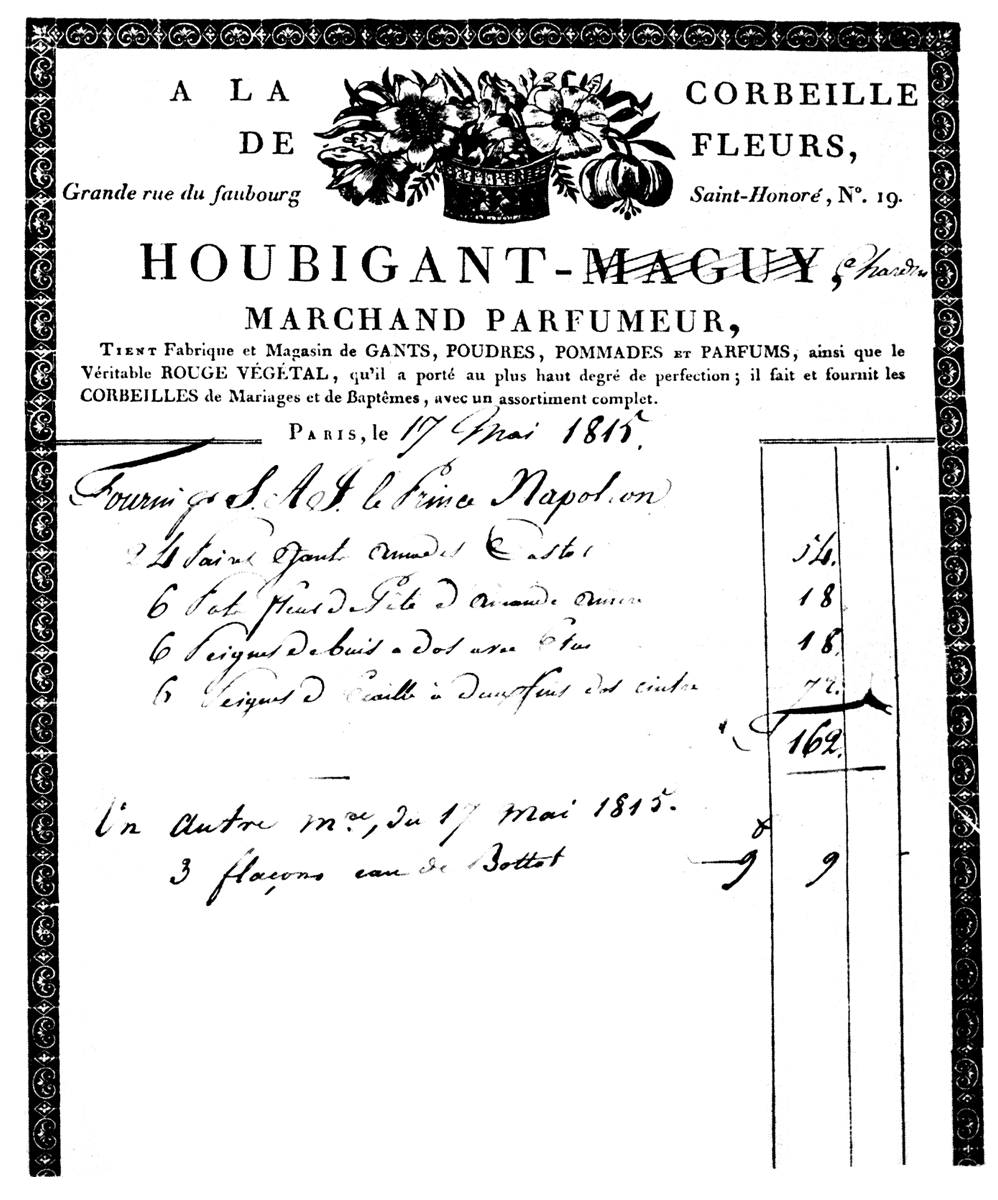
Jean-François Houbigant (1752-1807) launched his perfume business at 19, Faubourg Saint-Honoré, Paris, in 1775. Houbigant was twenty three years old at the time and — so it is said — arrived at the location of his new business with a basket of flowers. The Basket of Flowers became the sign over his shop and, for many years, the address given at the top of his invoices.
Enrolled in the appropriate guild — the Perfumers and Glovemakers — Houbigant was permitted, under law, "to make and sell all kinds of scents, powders, pomades, pastes to whiten and clense the skin, soaps, toilet-waters, gloves, mittens and skin material."
An 1801 Houbigant handbill advertised that:
At the Sign of the Basket of Flowers,
Manufactures and Sells Gloves, Powders, Pomades and Perfumes; also the genuine vegetable Rouge which he has perfected to the highest degree. He makes and supplies Corbeilles de mariage et Baptêmes with every requisite.Grande-Rue du Faubourg Saint-Honoré Houbigant Merchant - Perfumer |
Makeup, for society ladies, was very much in demand and Houbigant's customers were the rich and the royal. Men and women of society both made great use of perfume and scented products to the extent, it is said, that the Marquis de Granford ordered his troops to put on perfume before the went into battle.
In 1775, when Houbigant opened shop, the area around Faubourg Saint-Honoré was a new district and considered very fashionable. Fine houses were being built. The Colisée was attracting fashionable society with its various diversions. The beautiful (rich) people were flocking to the district and Houbigant's wares were not overlooked.
A Houbigant account book which survived into the 20th century records sales between 1777 and 1782. Listed among Houbigant shoppers were clerical clients including the abbé d'Osmond, the curé of Tillenl, the abeé de Pinguilly, the Bishop of Aire and the Abbess of the Parc-aux-Dames. Marquises included de Grammont, de Girac, de Gontaut, de Marigny, de Boisgelin ... countesses included de Matignon, d'Hérouville, de Pontchartrain, de Damas ... marquis included de Polignac, de Pressac, de Lostanges, de la Roche-Lambert ... vicomtes de Choiseul and de Loménie. And then there was Monsieur de Maison Rouge. And this is just a sprinkling of names from this one account book. A 1790 invoice is made out to the Comtes de Sax, the daughter of the Prince Xavier of Saxony, uncle to Louis XVI.
But the great Houbigant legend — not verified — is that Marie Antoinette, in disguise on her flight to Varennes, was wearing a Houbigant fragrance, which caused her to be identified as royalty when her coach was stopped, because none but royalty would have possessed such a magnificent perfume!
Amazingly, or perhaps not so amazingly, the French Revolution hardly caused a dent in Houbigant's sales curve. The newly empowered craved perfumes no less than those who had been swept away. Then, when the Empire succeeded the Directoire, the House of Houbigant rose to new heights.
In 1829, Houbigant was appointed perfumer to Her Royal Highness, the Princess Adélaide d'Orleans. In 1838, England got on board and Houbigant was appointed perfumer to the Queen. The Empress Eugénie was a Houbigant customer, as was Napoleon III, who, the records show, had his account closed on July 19, 1870.
When Jean-François Houbigant died in 1807, he was succeeded by his son, Armand-Gustave Houbigant (1790-1863). In addition to being head of the House of Houbigant, Armand-Gustave distinguished himself as an artist, a Legion of Honor awardee, and, for several years, the mayor of Nogent-sur-Oise, the town where he had taken up residence and in which he died.
The next chapter of the Houbigant story begins with Armand-Gustave Houbigant's successor, perfumer Paul Parquet.
Fougère Royal
Perfumer Paul Parquet became joint owner of the Houbigant business in 1880. It was under his direction that manufacturing and administration were moved to Neuilly-sur-Seine were facilities could be expanded. Staffing was increased, laboratories were installed. Houbigant was preparing for a new age.
It has been said that Paul Parquet was the first perfumer to understand the importance of the new synthetic aroma materials. The first of these were simply synthetic substitutes for aroma materials derived from natural sources. Later would come the synthetics for which there were no corresponding natural materials.
In 1882, Parquet introduced Fougère Royal, a fragrance that would define a type of perfume — the "fougère" (or fern-like) fragrance family. But even more important, Fougère Royal was build around an accord of oakmoss, geranium, bergamot ... and synthetic coumarin.
As a footnote we might add that, while today we praise this fragrance for the first known use of a synthetic in perfumery, at the time it was introduced, Houbigant preferred not to mention its use of this material. Rather, there was talk about "scientific methods put into practice commercially", implying only that Houbigant's fragrances were developed using very modern production methods, i. e., the emphasis was on quality.
During this period, Houbigant stretched out its commercial arms around the world. Under the direction of the Paris office, offices were established in the United States, England, Belgium, Holland, Switzerland, Italy, Spain, Poland, Romania. Connections were made in Havana, Buenos-Aires, Rio-de-Janeiro, Australia, Japan, and China.
The New York office had its own manufacturing facility distribute Houbigant goods to "all parts of the country."
Paul Parquet's creativity didn't stop with Fougère Royal. He continued introducing perfumes using synthetic materials and, in 1900, introduced Le Parfum Ideal, in 1908, Couer De Jeanette, and in 1910, Parfum Inconnu.
Houbigant perfumer Bienaimé picked up the ball from Paul Parquet and, in 1912, introduced Quelque Fleurs, one of Houbigant's all time great fragrances. Bienaimé left Houbigant in 1935 to found his own house. But, during the post-Parquet, pre-1950's period, Houbigant had the services of perfumers Paul Schving and Marcel Billot. It was Marcel Billot who was responsible for another great Houbigant fragrance, Chantilly, launched in 1941.
The Modern Era
In 1993 Houbigant filed for chapter 11 bankruptcy protection in New York listing liabilities of $52.5 million and assets of just $23 million. Part of the losses were blamed on a French manufacturing facility which was not proving to be profitable.
In 1994, Houbigant give a license to a start-up company, Renaissance Cosmetics, Inc., to manufacture and market twelve Houbigant fragrances using the Houbigant name. Formulae for the fragrances were included in the deal.
Renaissance itself filed for bankruptcy protection in 1999.
The years between 1994 and 1999 saw much litigation which included complaints by Houbigant that its fragrances were being "watered down" and its name was being used in ways not contemplated by the licensing agreement. Ultimately, when these complaints were settled, Houbigant litigated with Renaissance's insurers over the same claims.
The watering down accusation presents something of a puzzle because Renaissance clearly stated that its goal was to sell fragrances to mass merchants — drug store chains and discounters — rather than Houbigant's elite 19th century clientele. The days of marketing to royalty were over. Not only did Renaissance need the famous Houbigant brand names, they needed affordable compounds that could be sold profitably in a market that allowed only the thinnest of markups.
When the dust finally settled, Renaissance had vanished, Houbigant was no longer a perfume maker, and the Houbigant name became legally attached to fragrances that had come a long way from their original formulations. With the notable exception of Quelques Fleurs (which had been committed elsewhere), a company ... and then two companies ... called "New Dana" emerged with the legal right to use the "Houbigant" name in connection with a number of Houbigant fragrance trade names on fragrances they manufactured themselves. Houbigant had ceased policing its classic fragrances for compliance with the originals.
Perfumes By Houbigant
| Fragrance | Perfumer | Bottle |
| Fougère Royale (1882) | Paul Parquet | |
| Le Parfum Idéal (1896) | Paul Parquet | |
| Violette Pourpre (1907) | Paul Parquet | |
| Coeur De Jeanette (1908) | Paul Parquet | |
| Parfum Inconnu (1910) | Paul Parquet | |
| Lilac (Date Unknown) | Robert Bienaimé | |
| Quelques Fleurs (1912) | Robert Bienaimé | |
| Parfum d'Argeville (1913) | ||
| Quelques Violettes (1913) | Robert Bienaimé | |
| Mon Boudoir (1918) | Robert Bienaimé | |
| Subtilite (1919) | ||
| Un Peu D'Ambre (1919) | Robert Bienaimé | |
| Rose France (1920) | ||
| Le Temps de Lilacs (1921) | Robert Bienaimé | |
| Au Matin (1923) | Robert Bienaimé | |
| Au Bois (1923) | ||
| Bois Dormant (1925) | Raymon Kling | |
| Celle Que Mon Coeur Aime (1925) | Robert Bienaimé | |
| Curiosite (1925) | ||
| La Belle Saison (1925) | Robert Bienaimé | The bottle for La Belle Saison was created by René Lalique. |
| Un Parfum Precieux (1927) | ||
| Au Loin (1928) | ||
| Essence Rare (1928) | Paul Schving | |
| Au Matin (1929) | Robert Bienaimé and Paul Schving | |
| Chiberta (1930) | ||
| Allegorie (1931) | ||
| Avant Premiere (1931) | ||
| Avante Scene (1931) | ||
| Cadence (1931) | ||
| Consecration (1931) | ||
| Etude (1931) | Marcel Billot | |
| A Demi Mot (1932) | ||
| Abandon (1932) | ||
| Autre Chose (1932) | ||
| Contraste (1932) | ||
| Croquis (1932) | ||
| Cle Des Champs (1934) | ||
| Boutade (1935) | ||
| Chasse-Croise (1935) | ||
| Chantilly (1941) | Marcel Billot | |
| Air Nouveau (1945) | ||
| Anneau D'Or (1945) | ||
| Fougère Royale - Reissue (1959) | Enrico Donati | |
| Ambergris (1973) | ||
| Civet (1973) | ||
| Monsieur Musk (1973) | ||
| A Rose Is A Rose Is A Rose (1975) | ||
| Ciao Houbigant (1980) | ||
| Raffinée (1982) | ||
| Les Fleurs (1983) | ||
| Presence (1984) | ||
| Lutèce (1984) | ||
| Demi-Jour (1987) | ||
| Sportsman (1988) | ||
| Duc de Vervins (1991) | ||
| Quelques Violettes (1996) | ||
| Quelques Roses (1997) | ||
| Aperçu (2000) | ||
| Quelques Fleurs Royale (2004) |
If you have any information you would like to share with us about Houbigant, please use the message sender below.
Blogger Evan has pulled out an old Houbigant order from Napoleon Bonaparte dated May 17, 1815, a month before his defeat at Waterloo. Ironic how after first serving the Kings and Queens of France, Houbigant continued taking generous orders from the people who replaced them. Among other items, Napoleon appears to have been buying gloves. We do know that he was a heavy user of cologne and kept a bottle in his boot ... and sometimes went through several bottles a day. Here's a link to Evan's photo of Napoleon's order: Napoleon's pre-Waterloo Houbigant order. |


Philip Goutell
Lightyears, Inc.