
Lightyears Collection
Jeanne Lanvin
(1867-1946)
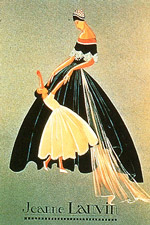
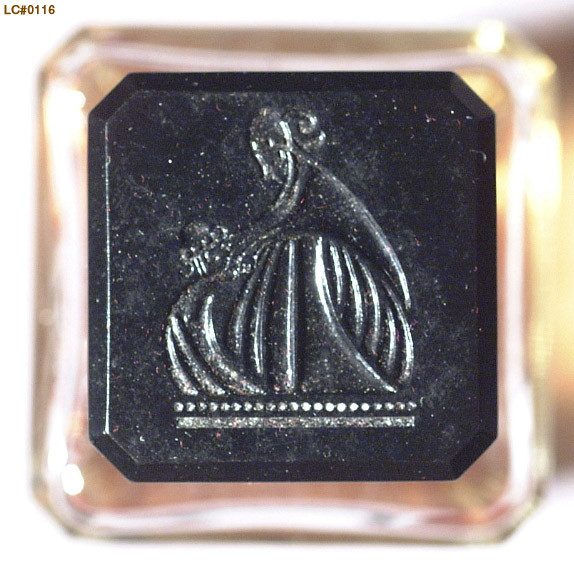
Jeanne Lanvin began her career at age 13, working for a milliner. by the age of 16, she was apprenticed to the house of Felix and, by age 18, she was creating and selling her own hats to retail stores. Interestingly, Lanvan's contemporary, Gabrielle Chanel, also started in business by creating and selling hats and, life Lanvin, came from an unstable family background. Lanvin was the oldest of eleven children born to a stuggling journalist, Bernard-Constant Lanvin, and his wife, Sophie-Blanche. The mere fact that she went to work at age 13 suggests that the family was not awash with money, however cultured they might have been. From the House of Felix, Lanvin moved to Barcelona, to work for the House of Cordeau. This was the age of hats and Lanvin had the knack. Her star was rising, along with her income. Returning to Paris, after several moves Lanvin established herself in business at 22, Rue du Faubourg Saint-Honoré in 1889. Jeanne Lanvin, S.A., still occupies this address. Lanvin's business evolved from hats to dresses. Like her hats, her dresses met with great success. (The daughter of Texas' first native-born governor, James Stephen Hogg, Ima (born 1882), was known to favor Lanvin's creations.) By the 1920's, Lanvin was at the height of her success and, like Paul Poiret and Gabrielle Chanel, she took the plunge into perfume. By 1925, working with the mysterious Russian emigree, Madame Zed, Lanvin had — on a very small scale — launched no less than fourteen fragrances, none of them proving memorable or commercially successful. In 1926, however, Zed, it is said, created Mon Peché ("My Sin") for Lanvin. At last Jeanne Lanvin had a perfume that was making money. Riding high on the success of Mon Peché, Lanvin set up her own laboratory near her workship in Nanterre. Perfumer André Fraysse was given charge. In 1927, in collaboration with fellow perfumer, Paul Vacher, Fraysse gave Lanvin Arpege, a huge success for Lanvin which is still being restructured and spun off into other Lanvin products today. When Jeanne Lanvin died in 1946, at the age of 79, her daughter Marguerite (who had always appeared with her mother on the company's famous trademark) took charge of the business. Marguerite died in 1958. In 1990, Lanvin was purchased by Group L'Oreal. Today it is, once again, an independent company (under new ownership.) Lanvin continues to create new fragrances which are now distributed under license by Inter Parfums. The famous Lanvin trademark, which continues to appear on all Lanvin products, was derived from a sketch by artist Paul Iribe of two woman, which symbolized Jeanne Lanvin's love for her daughter, Marguerite (also known as Marie-Blanche). |
Perfumes By Lanvin
| Fragrance | Perfumer | Bottle |
| Niv Nal (existed by 1925) | Masdame Zed | |
| Irise (existed by 1925) | Madame Zed | |
| Kara Djenoun (existed by 1925) | Madame Zed | |
| Le Sillon (existed by 1925) | Madame Zed | |
| Le Chypre (existed by 1925) | Madame Zed | |
| Comme-ci, Comme-ca (existed by 1925) | Madame Zed | |
| Lajea (existed by 1925) | Masdame Zed | |
| J'en Raffole (existed by 1925) | Madame Zed | |
| La Dogaresse (existed by 1925) | Madame Zed | |
| Ou Fleurit L'Oranger (existed by 1925) | Madame Zed | |
| Geranium d'Espagne (existed by 1925) | Madame Zed | |
| Apres Sport (existed by 1925) | Madame Zed | |
| Jeanne Lanvin (existed by 1925) | Madame Zed | |
| Cross-Country (existed by 1925) | Madame Zed | |
| My Sin (1925) | Madame Zed | |
| Arpege (1927) | André Fraysse and Paul Vacher | Albert Armand Rateau featuring trademark based on Paul Iribe sketch. |
| L'Ame Perdue (Lost Soul) (1928) | André Fraysse | |
| Petales Froisses (1928) | André Fraysse | |
| Scandal (1933) | André Fraysse | |
| Eau de Lanvin (1933) | André Fraysse | |
| Eau de Cologne (1934) | André Fraysse | |
| Rumeur (1934) | André Fraysse | |
| Pretext (1934) | André Fraysse | |
| Creschendo (1960) | ||
| Monsieur Lanvin (1964) | ||
| Vetyver Lanvin (1966) | ||
| Via Lanvin (1971) | ||
| (relaunch) Rumeur (1979) | ||
| Lanvin for Men (1979) | ||
| Cardamome (for the Middle East market - 1979) | ||
| Clair de Jour (1983) | ||
| eau de parfum Arpege (1987) | ||
| (relaunch) Arpege (1992) | ||
| Lanvin L'Homme (1997) | ||
| Oxygene (2000) | ||
| Oxygene Homme (2001) | ||
| Eclat d'Arpege (2002) | ||
| Lanvin Vetyver (2003) | ||
| Arpege pour Homme |
If you have any information you would like to share with us about Jeanne Lanvin, Lanvin perfumes or today's Lanvin enterprise, please use the message sender below.
|
|


Philip Goutell
Lightyears, Inc.
